
Vacuum Compression Luggage Wholesale Buyer Guide
Compare vacuum compression luggage structures, carry-on dimensions, pump routes, MOQ, customization, quality checks, packing, and quote requirements for B2B orders.
Buyer summary
What to know before requesting quotes
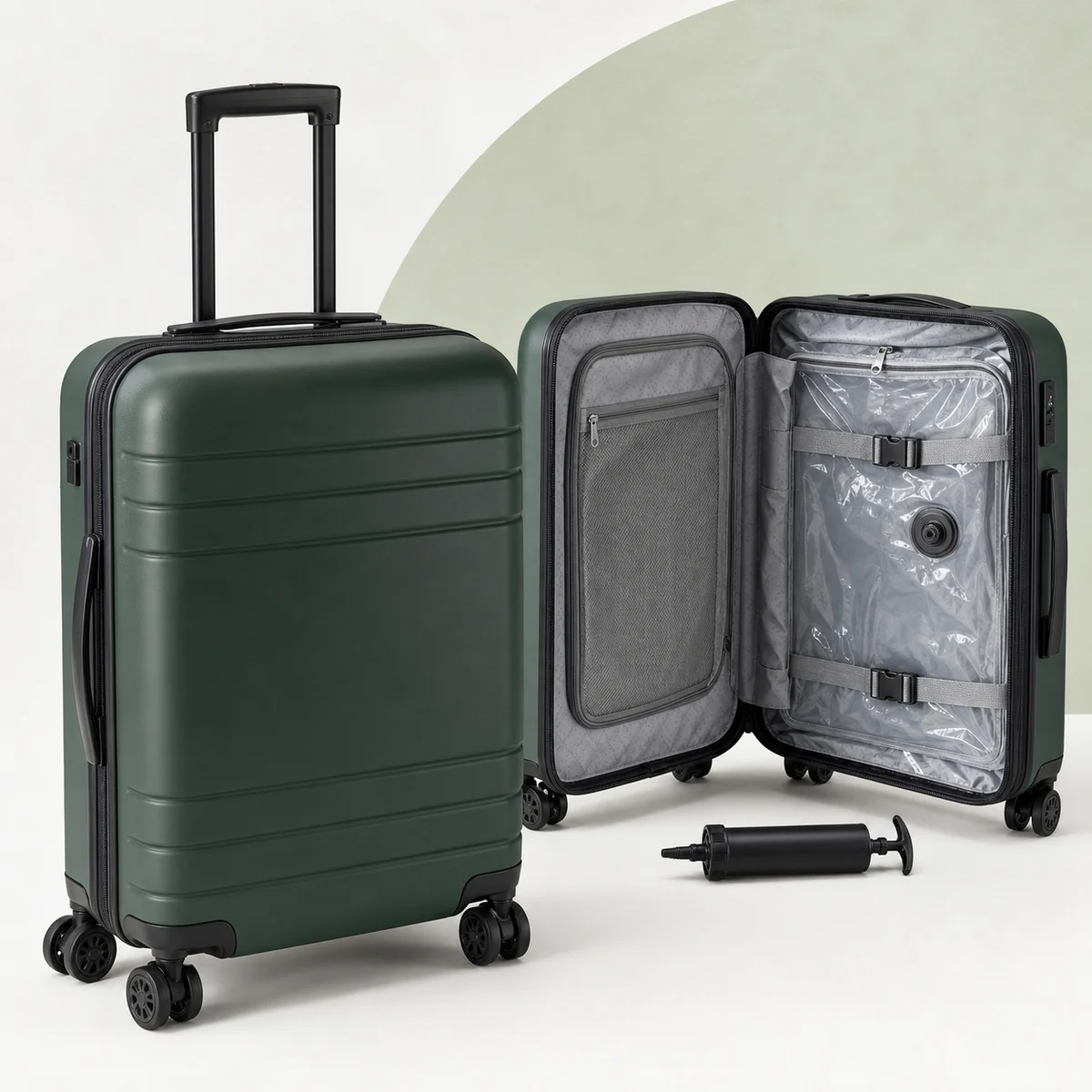
- Vacuum compression luggage combines a conventional hard-shell trolley case with a reusable internal compartment that removes air from packed clothing.
- An integrated compartment is attached to the suitcase lining and gives the interior a clean, organized appearance.
- A product described as 20-inch luggage is not automatically accepted by every airline.
- PC and PC-ABS are common hard-shell routes, while zipper and aluminum-frame closures create different costs, weights, packing volumes, and inspection points.
What vacuum compression luggage is
Vacuum compression luggage combines a conventional hard-shell trolley case with a reusable internal compartment that removes air from packed clothing. The system normally includes a zippered compression bag, a one-way valve, and a compatible manual or powered pump. It can create a useful premium feature for travel rewards, hospitality programs, employee mobility gifts, and branded luggage collections.
The compression system does not remove the need to evaluate the suitcase itself. Shell construction, closure, wheels, trolley, handles, lock, lining, compartment seams, valve, pump, instructions, and protective packing all affect the final product. Buyers should compare a complete approved sample rather than treating the inner bag as an isolated accessory.
Choose an integrated or removable compression route
An integrated compartment is attached to the suitcase lining and gives the interior a clean, organized appearance. The valve position, zipper access, usable volume, cleaning method, and replacement plan should be checked because the compartment cannot always be removed easily.
A removable compression organizer can be taken out for loading, cleaning, or replacement. It may be easier to service, but the supplier must confirm how it is secured inside the case and whether it moves during travel. Ask to see both the expanded and compressed interior, then compare practical repacking rather than relying on a percentage-saving claim.
Confirm carry-on dimensions before approving the shell
A product described as 20-inch luggage is not automatically accepted by every airline. Exterior height, width, depth, wheels, handles, expansion, packed weight, and airline-specific rules all matter. Give the supplier a maximum exterior dimension target and verify the finished sample against the airlines or travel routes relevant to the campaign.
Compression can reduce the volume of soft clothing, but it does not reduce suitcase weight. The buyer brief and user instructions should make this clear so recipients do not overpack. If the program covers different countries or airlines, a conservative shell size may be more useful than maximizing internal volume.
Compare shell, closure, and mobility components
PC and PC-ABS are common hard-shell routes, while zipper and aluminum-frame closures create different costs, weights, packing volumes, and inspection points. Confirm shell material, finish, color, thickness route, zipper or frame alignment, corner protection, and whether expansion is compatible with the compression layout.
Check wheel movement, wheel attachment, trolley extension and return, handle attachment, lock function, and interior organization on the actual sample. A premium compression feature will not compensate for weak wheels, an unstable trolley, or poor carton protection during international shipping.
Select the pump and destination requirements
A manual pump is simple to pack and avoids electrical requirements, although compression takes more effort. USB-powered and rechargeable pump routes can be more convenient, but the buyer must confirm charging input, cable, battery route, labeling, instructions, transport restrictions, and any documents required by the destination market.
The bag valve and pump connector must be tested together. Request a sample using the exact valve, pump, cable, and compartment planned for production. Any performance or safety claim should be supported for that selected system rather than copied from a generic marketplace listing.
Plan customization, MOQ, and sampling
Common branding routes include a logo plate, printed shell mark, UV print, trim badge, lining label, zipper pull, protective cover, insert card, and retail carton. Select the method from the shell surface, artwork, durability expectation, and quantity. Avoid placing important artwork where it may be hidden by handles, protective film, or retail labels.
A typical quotation discussion may begin around 200 to 500 pieces for an existing compression-luggage construction, while exclusive colors, changed hardware, electrical pump routes, or new tooling can require a higher commitment. Treat this as a planning range, not a fixed promise. Sampling and bulk production timing should be confirmed after the complete specification and destination requirements are known.
Build a vacuum luggage quality checklist
Inspect exterior dimensions, shell appearance, color, closure alignment, lock, wheels, trolley, handles, lining, pockets, straps, and branding. For the compression system, check bag seams, zipper seal, valve fit, valve cap, pump connection, short-term seal retention, access while packed, and whether the compartment can be opened and reused without damage.
Also confirm instructions, warning copy, cable or battery route where applicable, set count, protective cover, individual packing, barcode, carton dimensions, carton marks, and drop-protection plan. Agree on the sample standard and practical test method before production so the buyer and supplier are checking the same result.
Send a quote-ready vacuum luggage brief
Include the campaign use, recipient, estimated quantity, destination, delivery date, required exterior dimensions, shell route, closure, color, wheel and trolley preference, compression-compartment structure, valve, pump type, logo artwork, packing, and document requirements. State whether the supplier may recommend an existing model or must follow a fixed construction.
Ask for clearly separated options when details are still open. For example, compare a manual-pump route with a USB-powered route, showing the complete specification, MOQ, sample plan, bulk-production estimate, packing dimensions, and cost differences. This produces a more useful decision than requesting one price for an undefined smart suitcase.
Frequently asked questions for buyers
What is a typical MOQ for custom vacuum compression luggage?
Existing compression-luggage constructions may begin around 200 to 500 pieces, but the confirmed MOQ depends on shell model, color split, pump route, branding, packing, hardware changes, and production schedule. New tooling or exclusive components usually require a larger commitment.
Does vacuum compression make luggage lighter?
No. Removing air can reduce the volume of compressible clothing, but it does not reduce the weight of the contents. Buyers should verify airline dimensions and weight rules separately and avoid unsupported packing-capacity claims.
Which pump is better for a promotional luggage program?
A manual pump is simple and avoids electrical requirements. USB-powered or rechargeable pumps may be more convenient but require confirmation of charging, battery, labeling, documentation, and transport needs. The best route depends on destination, target value, and recipient use.
What should be tested before bulk production?
Approve the complete suitcase and compression system together. Check exterior dimensions, shell, closure, wheels, trolley, handles, lock, lining, compartment seams, zipper seal, valve, pump fit, short-term seal retention, branding, instructions, and protective packing.